Standardized Patient Management System
Frequently Asked Questions

Navigation
FAQs for Penn Med SPs
Here are some procedural questions SPs have asked. To submit additional questions, please use the Contact Staff link.
Why wasn't I called back for a program? I was told I did a great job.
In a perfect world, there would be exactly as much work as everyone wants. We try our best to be equitable while also meeting the requirements of each program. When it comes to casting, these are just some of the things we need to consider:
- Strike a balance of rehiring SPs who have done the program already, and bringing new people on board.
- Meet demographic requirements, which vary across programs, and frequently change from year to year depending on the curriculum and faculty requests.
- Come up with training times and rooms that don’t conflict with other events, and that all the SPs can attend.
- Minimize having learners meet with SPs they have seen previously.
How do you decide the racial demographics portraying various cases? Why are some cases all white or all black SPs?
We always strive for a diverse mix of SPs, while also factoring in SP experience and availability. Occasionally, course directors have a specific demographic in mind because the SP case correlates to other course instruction around cultural competency/cultural humility, for instance. The intent is not to reinforce stereotypes about any group, but rather to provide learners with an isolated experience with a patient that aligns with some specific learning objective(s).
How do you decide the age demographics portraying various cases?
Our SPs range in age to 18-90, with a handful of pediatric cases thrown in as well. Sometimes the age in an SP case matters for medical reasons, and that is decided by faculty or course directors. Occasionally SPs will age out of one case, but this does not mean SPs age out of our program. We have about 200 cases across all programs, and are always growing.
How do you decide the gender demographics?
Some medical conditions are gender-specific; faculty/course directors tell us when a case needs to be portrayed by a male, female or other. We have been working on increasing the number of transgender or non-binary SPs for programs in which gender issues are part of the learning objectives, and also when gender issues are not part of the learning objectives. We aim for as much diversity as the standardized nature of our work allows. For example, we would not want 3 male SPs and one female SP to portray a case about abdominal pain when there are time constraints, as data-gathering for the female patient would be more extensive.
Why do callouts for some programs say that actors are preferred? Don’t you think non-actors can do just a good a job as actors?
Some cases require skills that many actors possess—for example, commanding attention in a large venue, or portraying high levels of emotion quickly in an artificial setting. We may start with actors for those types of roles, particularly if we are reaching out beyond our current SP pool to unknown applicants. However, there are exceptions to every rule. We know that not all actors make good SPs for any number of reasons, and many great SPs may not have been trained as actors. For that reason, we hire SPs from varied backgrounds for all types of programs.
Who is my trainer? What is a PA? Wasn’t that person an SP like me last week?
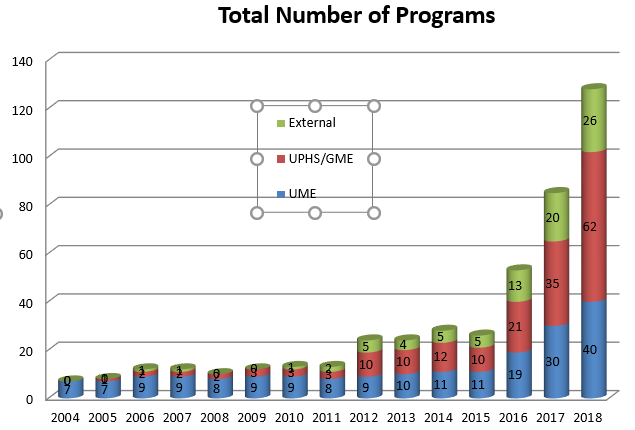
Our program has increased 18 fold in the past 15 years. See chart below for reference. To keep pace with this explosive growth, we instituted the practice of hiring SPs to sometimes work as Program Assistants (PAs). PAs are part-time, temporary staff who primarily train SPs to perform cases. We hire people to work either as a PA or an SP in a given program. The next time you see a PA, they may be in the role as SP. We recognize that sometimes the SPs who are receiving training may in fact have more experience with a case than their trainer. It’s important for all parties to keep in mind the PA’s role is to facilitate the learning process and support the SPs. Collaboration and trust are key.
PAs do other tasks including but not limited to: proctor; set-up and break-down of rooms; track inventory; conduct quality-assurance activities; assist in case writing; help develop other supplemental materials such as schedules, evaluations; provide general support to SPs in terms of making sure they know where they’re going, answering procedural questions; data entry; trouble-shoot; other special projects as needed. If you are interested in becoming a PA, contact one of the core SP Program Staff.
I’m not sure who’s in charge of what. If I have a question, whom should I contact?
The SP core team (Denise, Janice, Martina and Catherine) are in near-constant contact with each other, and our responsibilities overlap a great deal. Therefore, you can contact any of us by clicking the Contact Staff link at the bottom of SPMS, which automatically goes to all of us, and automatically tells us who sent the message. You can also feel free to email any of us. If we won’t be checking email for some reason, you’ll receive an automated response asking you to contact someone else. Our contact information is here, on the Helpful Penn Resources page. Note, program assistants (PAs) may not receive or relay a message to the team in a timely fashion so they should never be your primary contact unless otherwise instructed.